
A Practical Low-Light Camera Evaluation Method
Evaluate useful image detail under documented lighting, motion and exposure rather than an isolated minimum-lux claim.
Prepared by Honglan Electronics
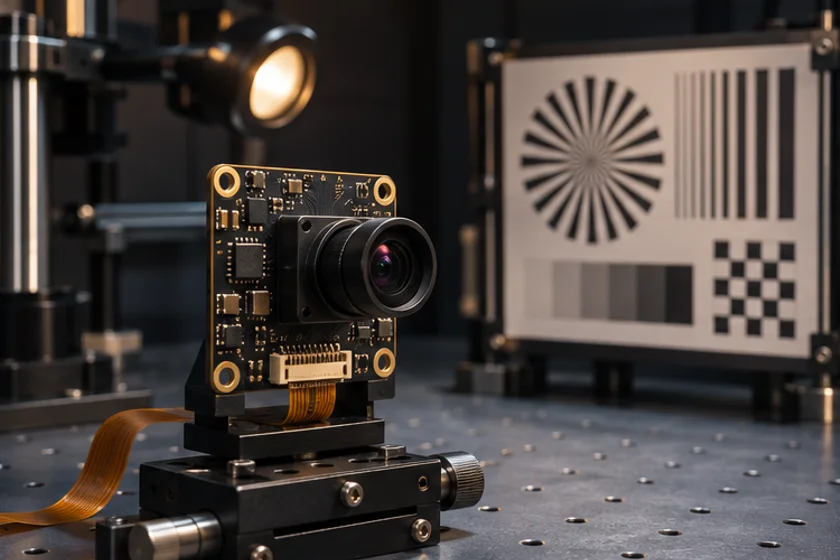
Evaluate low-light performance with a scene that represents the equipment's real task. A bright-looking image is not necessarily a useful image: processing can brighten noise, smooth away detail or conceal motion blur. Decide what information the image must preserve before comparing samples.
Define the lighting condition
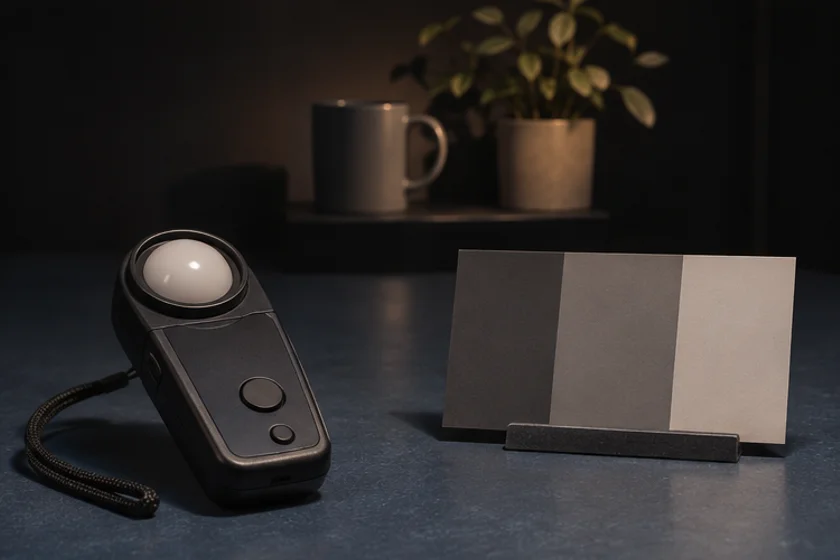
Describe the source, geometry, spectrum where relevant, target reflectance and ambient contribution. A light-level measurement without its location and measurement method is incomplete. Keep photographs of the setup and record whether the enclosure, window or protective cover was installed.
Use at least a nominal scene and a difficult scene. Include dark materials, reflective areas and the smallest target feature that matters. If the equipment uses infrared illumination, confirm the proposed optical path and operating conditions with the specific module documentation rather than assuming visible-light performance transfers.
Freeze the variables that affect the comparison
Use the same framing, target distance and output mode for each candidate. Record exposure, gain, white balance, noise-reduction settings and compression. If automatic controls remain enabled, record their resulting values and evaluate how quickly they settle after a scene change.
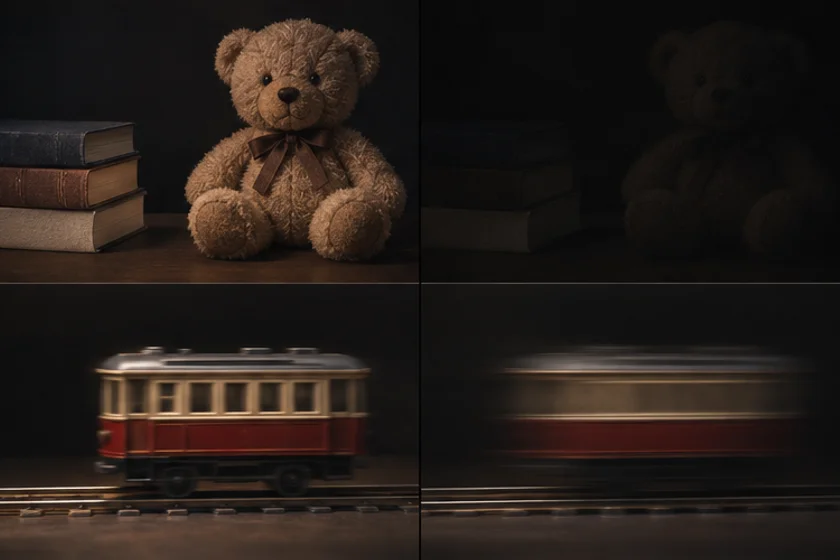
Compare a stationary target and a moving target separately. A camera may create an acceptable stationary picture by using an exposure that is too long for the intended movement. A purchasing decision should state which combination of lighting and motion was accepted.
Look for useful detail
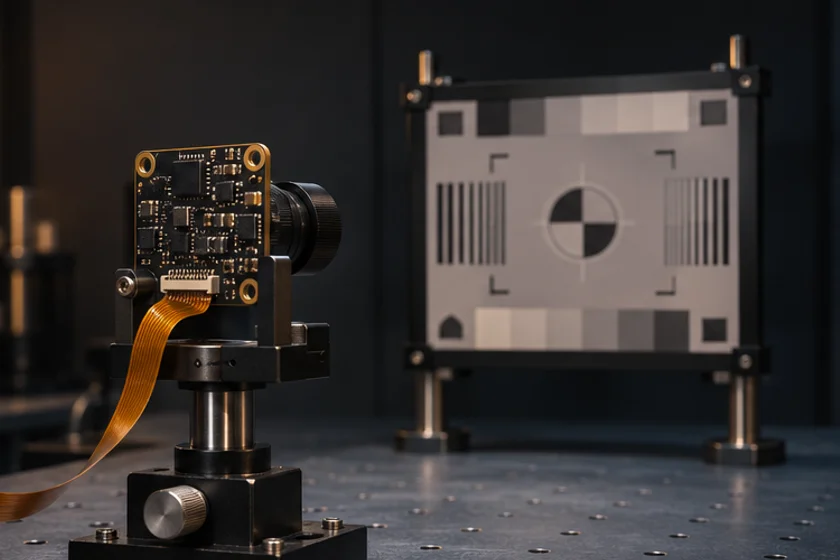
Review fine edges, low-contrast markings, dark textures and uniform patches. Check whether the intended algorithm can use those regions. Maintain original captures rather than assessing only resized images in a browser or document.
EMVA 1288 provides a framework for measuring and presenting machine-vision camera and sensor characteristics. Where an appropriate report is available, it can complement an application test. It does not replace testing the complete module with its actual lens, processing and illumination.
Use a stepped test sequence
- Establish a well-lit reference capture.
- Reduce illumination in documented steps.
- Repeat with fixed exposure and gain to understand the image changes.
- Repeat with the proposed production automatic settings.
- Add realistic target movement.
- Observe recovery when lighting changes abruptly.
- Repeat inside the final enclosure after warm-up.
At each step, score the application result, not just the visual appearance. Keep separate notes for noise, blur, colour behaviour and loss of detail. This makes it easier to determine whether a different lens, better lighting or another module is the appropriate next experiment.
Ask for comparable evidence
A minimum-lux statement needs context, including exposure, gain, lens aperture, output quality criterion and processing. Avoid ranking products by that value when the test conditions differ. Ask for original sample files and a complete settings record.
State the pass threshold in terms of your equipment's task. A monitoring display, a code reader and a measurement system can legitimately require different outcomes under the same illumination. Do not transfer acceptance from one application to another without checking the difference.
Use the sample test checklist to organize a repeatable comparison. When requesting a sample, describe the actual scene and provide safe, non-sensitive target examples so the proposed assembly can be discussed against your requirements.
Apply this to a camera module
If the challenge is a bright background as well as a dark subject, the PS5268 wide dynamic range board is a candidate for side-by-side scene testing.
Technical references
- Measure scene lighting
- Lock test conditions
- Step down illumination
- Compare useful detail
Is a lower minimum-lux specification always better?
Only when the measurement conditions and image-quality criterion are comparable. Verify the actual task with exposure and gain recorded.
Why does a bright low-light image still fail recognition?
Noise, smoothing, compression or motion blur may remove the detail needed by the algorithm.